

The legal marketing landscape, especially within the personal injury sector, has entered a new era—one shaped by increased competition, a fragmented media environment, and a client base that is often uncertain or inactive. These factors demand a more deliberate, phased approach to a law firm marketing strategy—one that allows firms to grow sustainably while adapting to changing dynamics.
Understanding the Shifting Legal Landscape
Competitive Saturation
The volume of personal injury cases remains largely stable, but the number of firms competing for those cases has expanded rapidly. From mid-career attorneys launching firms amid generational turnover to national players entering local markets, the legal field is now marked by greater saturation and escalating ad spend: We have seen a 42% increase in broadcast TV spend alone from 2014 to 2024. Traditional low-hanging fruit is increasingly scarce, and simple visibility is no longer enough to guarantee lead flow.
Fragmented Media Channels
The expansion of media options—ranging from broadcast and radio to programmatic display, TikTok, YouTube, and Google Local Services Ads—has multiplied opportunities but also created complexity. Without a cohesive strategy, firms risk diluted messaging, inefficient budget allocation, and lack of attribution clarity across campaigns.
Behavioral Inertia
Even as law firm marketing grows more sophisticated, many accident victims remain passive. PMP’s research shows that 55% of those involved in an accident do not contact an attorney within the first two weeks. Inaction, driven by misconceptions around legal fees, confusion about when representation is necessary, or hesitation to pursue claims, is often the most persistent barrier to conversion.
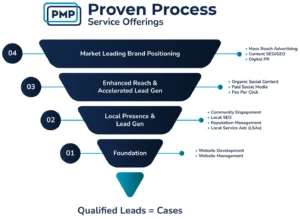
The PMP Proven Process: A Phased Approach to Strategic Legal Marketing
To address these challenges systematically, firms can adopt a staged framework aligned to business maturity, budget, and operational readiness. Each phase builds upon the last, ensuring foundational gaps are addressed before scaling efforts. While every firm and every market is different, the essential building blocks of a successful marketing strategy for personal injury law firms remains consistent.
Phase 1: Foundation
Objective: Establish digital infrastructure and performance hygiene.
- Website Development: A law firm’s website is often a potential client’s first impression. Beyond the basics—fast load times, mobile optimization, and clear messaging—conversion rate optimization (CRO) turns visitors into leads. Prominent calls-to-action (CTAs) and intuitive navigation guide prospects toward taking action, transforming passive browsers into qualified inquiries.
- Website Management: Routine hosting, security patching, and performance monitoring are prerequisites to long-term marketing success. A managed platform allows updates to occur without disrupting other campaigns.
This phase is considered “table stakes.” All other marketing strategies—from paid ads to SEO—depend on a fast, reliable website.
Phase 2: Local Presence & Lead Generation
Objective: Build community visibility and credibility to drive inbound demand.
- Local Search Engine Optimization (SEO): Local optimization focuses on Google Business Profiles, citation building, and acquiring local backlinks. This improves discoverability and increases ranking consistency across local search results.
- Reputation Management: Soliciting and responding to online reviews impacts not only perception but also ad performance (especially LSA).
- Local Services Ads (LSAs): Google’s pay-per-lead platform appears prominently in search and is weighted heavily by location, responsiveness, and review quality.
- Community Engagement: Local events, sponsorships, and partnerships build local market presence, create shareable social media content, and generate backlinks to boost local SEO rankings.
This phase helps firms move beyond referrals, establishing them as recognized, local law firm brands.
Phase 3: Enhanced Reach & Accelerated Acquisition
Objective: Expand lead volume and control the marketing funnel.
- Paid Social Media: Target audiences across platforms like Facebook, Instagram, and TikTok using precise demographic and behavioral filters. These ads are ideal for generating initial brand awareness, retargeting interested prospects, and fostering authentic engagement.
- Pay Per Click (PPC): High-intent users searching on Google can be directed to conversion-optimized landing pages, making PPC one of the most immediate performance channels.
- Organic Social Media: Maintaining a consistent publishing cadence builds brand familiarity and enhances remarketing efforts.
At this stage, firms gain more control over audience targeting and messaging, allowing for greater predictability in lead flow.
Phase 4: Market-Leading Brand Positioning
Objective: Solidify brand dominance and create separation from competitors.
- Mass Reach Advertising: Channels like TV, radio, billboards, and digital audio provide large-scale exposure. When combined with programmatic display and YouTube, these platforms create a pervasive brand presence across consumer touchpoints.
- Content SEO/GEO & Digital PR: Thought leadership in the form of longform articles, high-authority backlinks, and earned media placements improves search engine performance and generative AI results, elevating perceived expertise.
This phase is about establishing a distinct voice—positioning the firm as the obvious choice, not just a viable option.
Implementation: How to Activate the Proven Process
Regardless of where a law firm starts in its marketing approach, jumping to advanced tactics without first laying the foundational groundwork is a formula for disaster, leading to wasted resources and failed campaigns. Effective law firm marketing requires matching strategies to the firm’s current maturity while maintaining cross-departmental alignment.
Considerations:
- Scope Clarity: Avoid introducing new channels without fully activating current ones. For example, LSAs should follow reputation improvements, not precede them.
- Data Infrastructure: Attribution models and cross-platform dashboards (e.g., TapClicks or Google Looker Studio) are critical tools for evaluating ROI.
- Intake Readiness: A high-performing campaign can still fail if the firm is not prepared to handle increased volume or multi-touch follow-up.
Strategic legal marketing is not about chasing the next platform—it’s about honest assessment of current capabilities and deliberate planning for scale.
Conclusion
Firms that treat marketing as a system—not a series of disjointed tactics—will dominate the legal industry’s future. Adopting a phased framework helps firms avoid costly missteps, focus resources strategically, and grow with intention. This approach aligns marketing execution with firm maturity, turning complexity into opportunity.